
I shall begin, once again, by dropping a graph:
It’s pretty much the same graph that I dropped at the start of Rant No.1…
…but I found a more recent version from the IFPI that also includes 2024 data. It’s not as pretty, though:
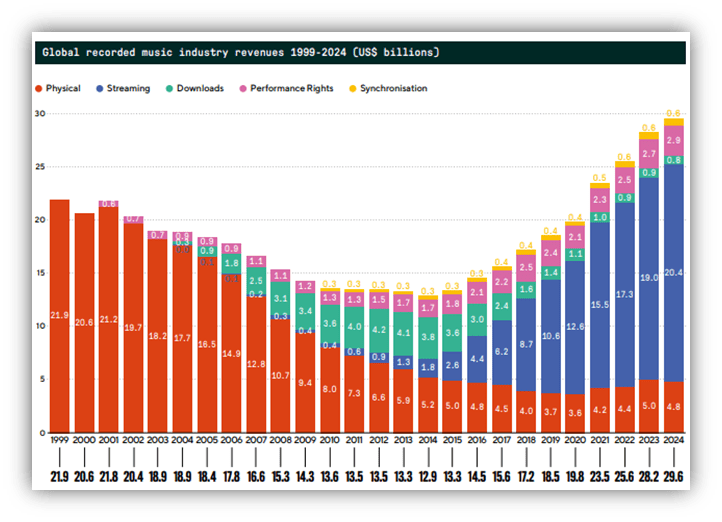
The graph that, the good people of the Internet will tell you, offers irrefutable proof, that Spotify has destroyed the music industry! That Spotify is the worst thing to have ever happened to music!!
And they will tell you that because they know one single fact: that Spotify only pays out a tiny amount of money per stream. An amount usually quoted as $0.004. And they will repeat that fact every time the topic of Spotify comes up, piping up with “did you know Spotify only pay $0.004 a stream?”
Or sometimes they say 0.004¢ a stream, which is a very different number, and presumedly the reason you’ll see people claim that the figure is “thousandths of a penny”, which is simply not true.
I’ve even seen it stated as $0.004¢ a stream, which is just plain confusing.
Pick a lane, people!!
I’m going to go with 0.4¢ because it’s the easiest to understand. You don’t need to go through the hassle of counting the zeroes to figure out how much it is. You’re welcome.
The exact figure is unimportant (also due to the complicating factor of multiple exchange rate conversions, difficult to calculate)
We know that the exact figure is unimportant because Weird Al Yankovic got blanket positive coverage – including one headline that literally began with “Weird Al Tells The Truth” – for a joke that was objectively a lie: that Spotify only paid him $12, or enough for a nice sandwich.
At 80 million streams Weird Al should have earned about $320,000. Or maybe a bit less since he presumedly needs to pay royalties for all the songs he has parodied over the years.
Now, obviously: Weird Al was making a joke – he is after all, a comedian – but do we want this to be a world in which a millionaire – Weird Al’s net worth? $20 million, Annual income? An estimated $2 million – novelty rock star can make a joke about only being able to afford one square meal a year and receive universal praise for it? Have we arrived at a point in our post-truth landscape where the definition of “truth” is whatever lie you want to make up about someone or something that society has collectively agreed it’s okay to make up lies about?
It’s possible that Weird Al chose that $12 figure because he read an article in Rolling Stone about the average musician on Spotify earning $12 a month. That figure is probably broadly correct (the Math checks out). But it’s also largely irrelevant. Low average musician earnings are merely the inevitable result of having virtually every song ever released available on the platform. That’s including those hits that have now been forgotten and are never played, those songs that were never hits to begin with and are never played, those tracks that are being uploaded right now by some kid in their bedroom and will probably never be played.
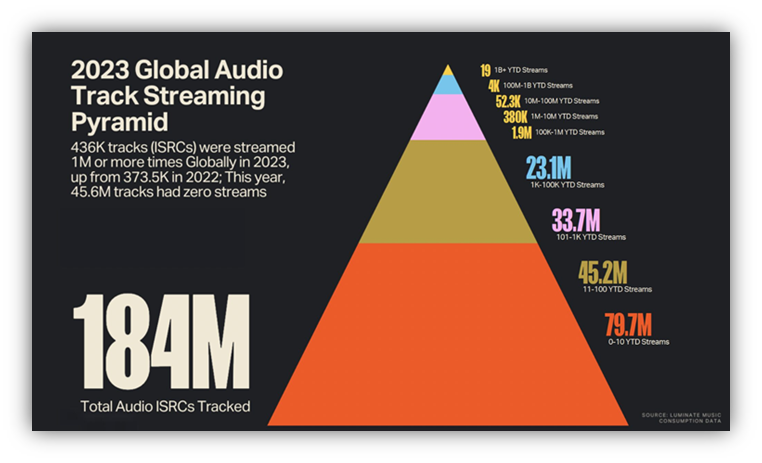
The vast majority of songs of Spotify are virtually never listened to… and a quarter of songs on Spotify have never been listened to at all!
The main reason for so much music not being listened to, is that more people are making music than ever before.
More music is uploaded everyday than the entire recorded output of 1989, apparently.
Hardly a sign that Spotify has destroyed music! How is music being destroyed when not only is the amount of revenue going through the roof, but supply is at an all-time high? So much so that some record company head honchos are complaining about oversupply, complaining that the ability of anyone, anywhere to share their music with the world is ruining all their meticulous efforts at gatekeeping.
Would it even be possible for Spotify to allow anyone, anywhere, to upload their music, whilst simultaneously guaranteeing that everyone that does so earns a living wage?
So, is a bit less than half a cent a stream a fair price, particularly given that once a song becomes a hit it very quickly earns a great many just-less-than-half-a-cents? I’m not convinced that the majority of Spotify’s critics really grasp just how big the streaming figures of hits are, but I’ll get to that later.
It says a lot that even those platforms that make a big deal out of paying more:

– such as Tidal at one cent a stream, more or less- don’t really pay that much more.
Clearly, somewhere between half-a-cent and a whole cent is the natural demand-meeting-supply price for a single stream of a song. It’s the price that created the conditions that led to the graph at the beginning of this piece!
And it’s not 0.4c a stream, anyway.
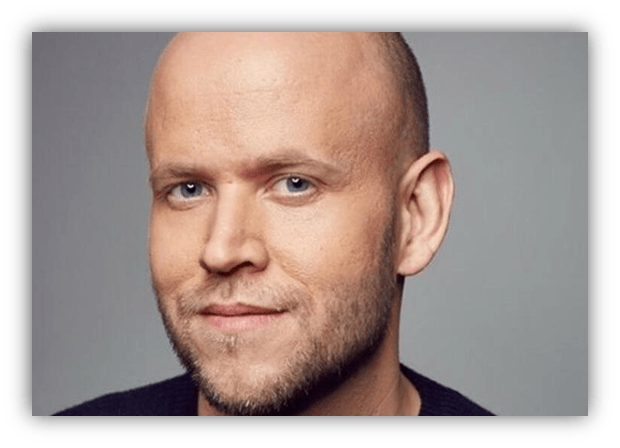
Daniel Ek did not sit down and evilly chuckle to himself, “how can we screw artists by paying them the least amount possible?”
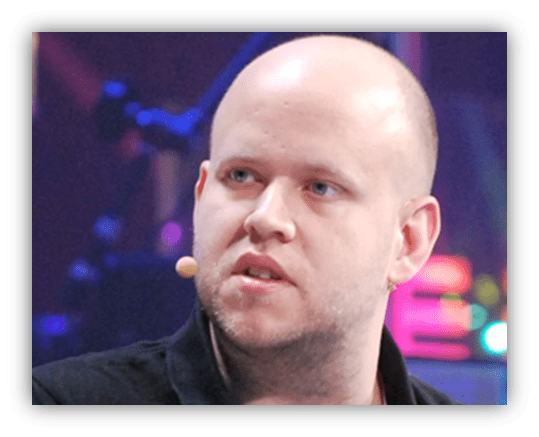
(And just admit it: at least half the reason you hate Daniel Ek so much is because he looks, and sort of talks, like a Bond villain.)
Instead he sat down:
- worked out how much users would likely pay a month for unlimited music,
- how much Spotify would cost to run,
- got into negotiations with record companies… and…
Look, I obviously don’t know the ins and outs of all of this but the end result was that rightsholders would get 70% of Spotify’s revenue with the remaining 30% going to making the whole thing work.
70% was also about the same amount as iTunes, so maybe that was the basis of negotiations. Maybe that’s the fair proportion of revenue to go to rightsholders when you don’t have to worry about things like packaging and manufacturing physical objects.
And it just so happens that 70% of revenue divided by the total number of streams works out to something like 0.4¢ a stream. But that 0.4¢ a stream is not set in stone. If the amount of revenue or the number of total streams changed, then so would the payment-per-stream.
Now, you can quibble that 70% is not enough, but it’s hard to quibble that it’s not quite a lot.
You also can’t quibble that it’s not pretty much the same as every other streaming service. Or that even if they gave out 100% – and their 7,000-ish employees consequently worked for free – it really wouldn’t increase the per-stream-rate all that much. Only to about 0.6¢ a stream.
It’s not as though Spotify is known for making big profits.
It’s far better known for not making any profits at all. At least not until 2024.
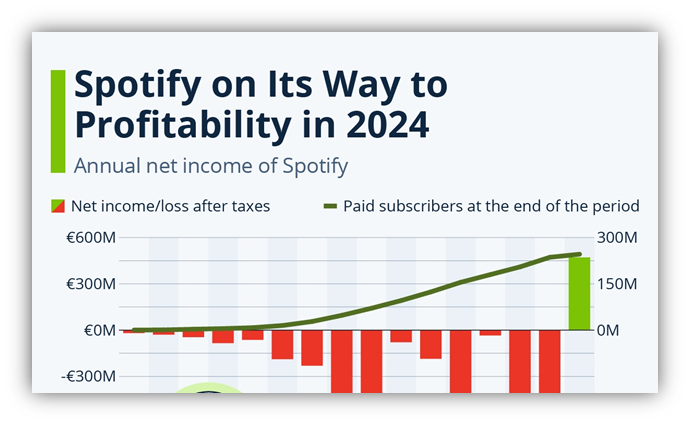
In the history of Spotify up to the moment I am writing this they have made an annual profit precisely once.
The reason Spotify’s per stream payment is lower than other streaming platform is… well, it’s complicated, but it’s mostly a mixture of…
- Offering free accounts supported by advertising, which although popular, and responsible for the majority of Spotify accounts (about 60%), does not appear to generate them much revenue (about 12%)
- Being popular throughout poorer parts of this planet where the subscription fee is lower because users wouldn’t be able to afford it otherwise. It’s not for nothing that the rise of Spotify has coincided with the rise of K-Pop, reggaeton and a growing number of pop stars from Africa (where Spotify is competing with Boomplay which costs $1-$2 a month)
- Spotify users apparently use the app more than subscribers of other apps. I’m not entirely sure why that is, although I can tell you it’s far less buggy than Tidal. And the more songs subscribers stream, the lower the per stream payment, simply due to the 70% of net revenue/total number of streams equation…. that’s just Math.
The only way for Spotify to increase the payment-per-stream would be to raise the subscription price. So be honest about that. Don’t just say “Spotify needs to pay more.” Say you, the consumer, need to be paying more. And much the same people who constantly claim Spotify is evil for inadequately compensating artists, also boast “they’re increasing subscription prices? That does it! That’s the final straw! I’m deleting my account!!!” making out as though quitting Spotify when they ask you to pay a little bit more is a self-righteous moral stance that helps struggling artists:
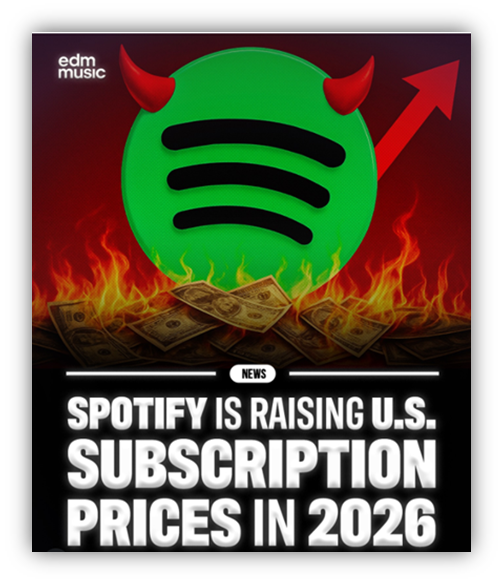
WHERE DO THEY THINK THE MONEY COMES FROM?!?
Or alternatively I guess, Spotify could eliminate the ad-supported free accounts which don’t appear to earn them much money anyway. This is probably because every time I’m in a store/café/restaurant that is playing the free-version.
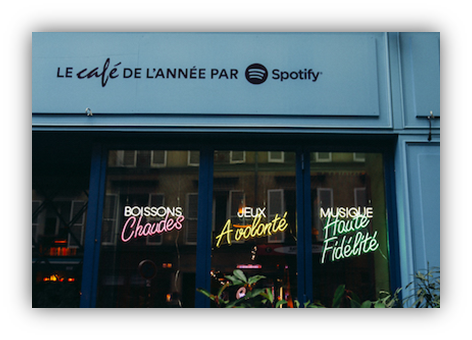
(And don’t think, store/café/restaurant owner that I’m not judging you, I know you can afford the A$12 a month subscription fee, I just bought a nice sandwich from you…)
About the only thing Spotify seems to be advertising is the Premium subscription version of itself. I once worked at a company that breathlessly announced that it was about to start advertising on Spotify. And all I could think was, “why are we advertising to a listener-base that self-identifies as cheap-skates?” It appears that much of the corporate world has wondered the same thing.
But be careful what you wish for. Spotify – streaming in general, but Spotify mostly – has attracted hundreds of millions of paying customers into the music market, largely due to its low price.
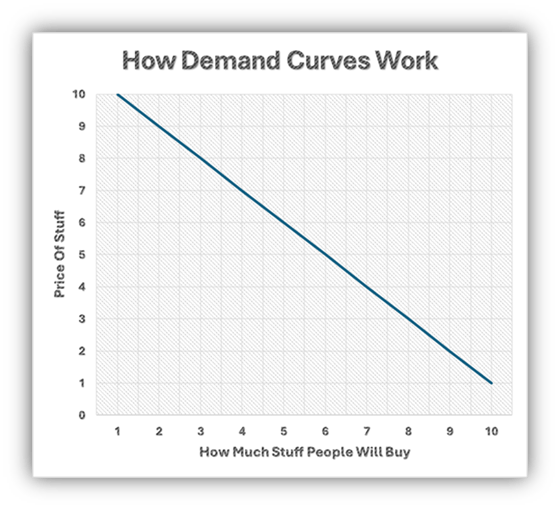
And Spotify is a large company. They presumedly have whole teams of mathematicians running the figures and economists drawing demand-and-supply graphs, and they’ve presumedly figured out that a higher subscription price will lead to less demand, and therefore less money flowing into the music industry, because that’s how demand curves work.
(Depending of course on how elastic the demand curve is, but you don’t want this rant to turn into an economics lesson).
Many of these paying customers that Spotify has attracted had previously been radio listeners who did not spend much money on music. Prior to Spotify, relatively few people did. Prior to Spotify the amount that people spent on music was pitiful.
What was the average record collection like before streaming?
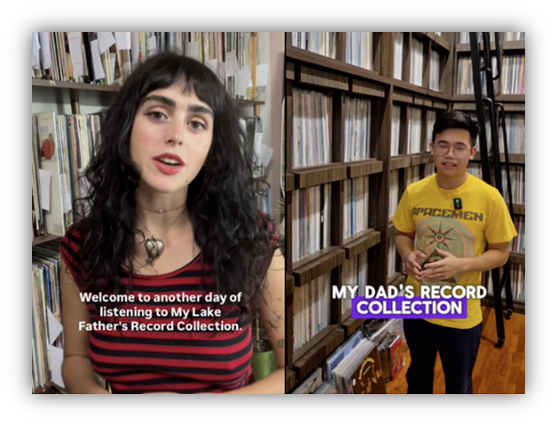
You might have gotten the impression from Instagram that everyone had shelves and shelves of records.
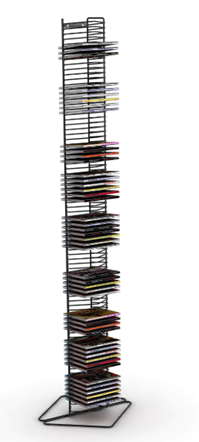
Shelves reaching so high you needed a ladder!
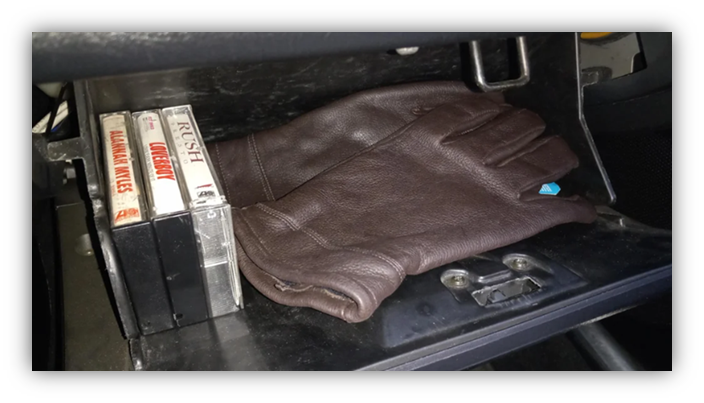
That, and a handful of cassettes bouncing around the glove compartment of your car.
How many people actually bought records previously?
The fact that even Thriller, after four decades, has only sold 70 million copies, and we are all supposed to be stunned at how humungous that number is, suggests that, as a proportion of the population, the answer is not many: less than 1% of the population of The World owns a copy of Thriller.
And those few who did buy records… they did not buy many.

President of a Nashville label service that specializes in independent artists, and very possibly the first person ever to liken Spotify to a utility like gas or water or electricity.
Now, although most articles that make this comparison consider it a bad thing – the presumption being that water and electricity are boring, and paying for a monthly subscription somehow demeans it – David actually meant it as a good thing… after all, water and electricity are not boring, they are an essential component of modern life!
Anyway, shush everyone: David is about to say something:
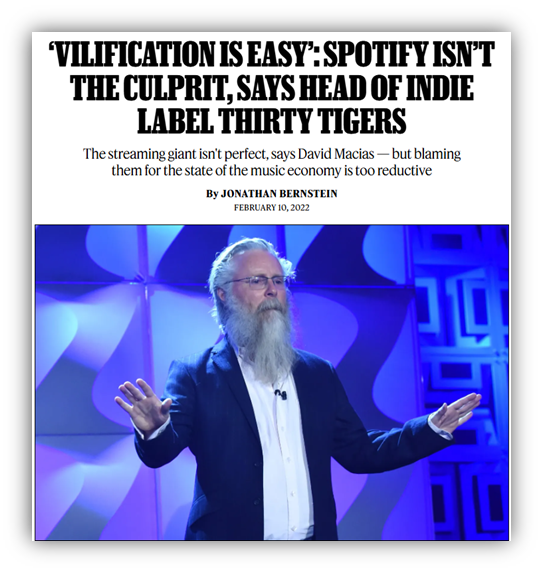
“I attended a music business conference presentation in the early 2000s, where the RIAA presented a study where they asked people who self-identified as avid music consumers how much money they spent a year on music.“
“The average amount was about $60 a year… if you want to subscribe to a streaming service you are contributing $120 a year to the till. The contribution of the average consumer has roughly doubled.”
$60 a year… that’s like… 4 CDs? And that’s “avid music consumers”?
I haven’t been able to find that particular music business conference presentation, but other research at about the same time showed that for “all consumers” – including the non-avid – the average spend on CDs was $25-$30 a year. Or about two CDs. And this was in the United States. In poorer countries it would be far less.
These are pitiful figures. In the streaming economy on the other hand, the figures are potentially mind-blowing (the extent to which they are mind-blowing being closely correlated to how susceptible you are to having your mind blown.)
Spotify alone has over 700 million users.
That’s about ten Thrillers! Michael himself has about 70 million streams each week… he’s streaming Thriller figures every week!
The Number One song on any particular day gets something like 7-8 million streams… A DAY!!!
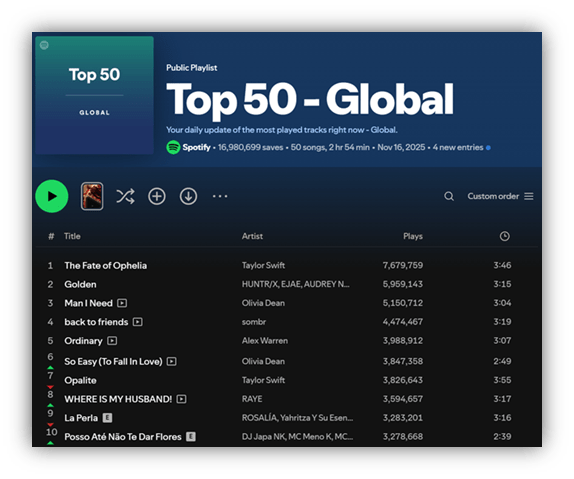
On Spotify alone!!! Across all platforms it’s probably over 10 million.
The 200th most streamed song on any particular day – today it’s “Payphone“ “by Maroon 5 – is still streamed more than a million times… a day!!
Streaming figures are so potentially mind-blowingly high that songs are going platinum that never even made the Top 40, simply because they found an audience bubbling underneath the charts and remained bubbling there for a lengthy period of time.
Now, I realize of course that a stream and a sale are not the same thing.
Many commentators seem confused on this point. They were particularly confused in the early days of streaming, when you could read article after article about rockstars not earning as much as they were expecting for “selling” a million “records”, when they had done nothing of the sort.
This article, for example, was referring to Lady Gaga’s “Poker Face” getting paid not very much for a million streams:
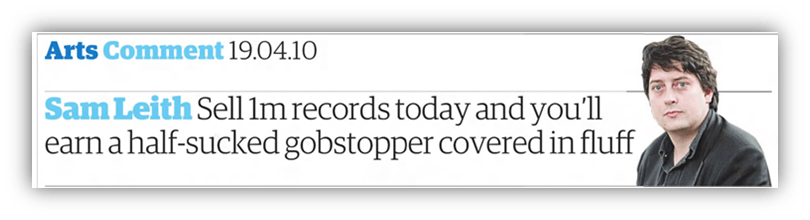
Back when so few people were using Spotify that a million streams sounded like a lot (“Poker Face”s streaming figures are currently closing in on 2 billion – increasing by more than a million streams every day – and she has nine songs with more than a billion streams… she also has close to 100 million “monthly listeners”… that’s four Australias!).
More to the point, it was a lie.
That “half-sucked gobstopper covered in fluff” – or $167 to be precise – only represented the publishing royalties (and therefore, not performer royalties, which were far higher) from one single country (Sweden) and didn’t even include the half of the publishing royalties that went to co-writer RedOne.
Sam knew this – he alludes to it in the article – and decided it didn’t matter – and wrote the article anyway. Neither did the facts stop the figure from being endlessly quoted in multiple articles for years after.
It’s illuminating to read the commentary from way back in 2010. Back when the reason artists weren’t making much money from Spotify was because nobody outside of Europe was using Spotify yet. It’s illuminating to see how little that commentary has changed.
Critics were saying exactly the same things back when Spotify was small and only paying $60 million a year in royalties as they are now when Spotify is paying out $10 billion. Everything has changed, but nothing has changed.
Except that now most people realize that a “stream” and a “sale” are not the same thing. You can still find people who use the terms interchangeably, but it is rare.
So many people were confused about the difference between “streams” and “sales” in the early days that Billboard felt it necessary to include trigger-warnings like this on its Spotify-related articles:
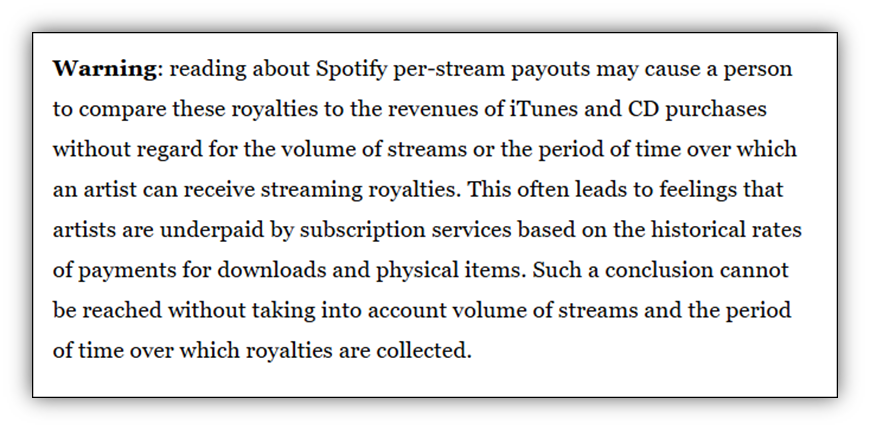
“The period of time over which royalties are collected.” That’s a critical point. I’d like to introduce you now to a concept I like to call The MC Hammer Principle.
MC Hammer, as I’m sure you’ll remember, had a huge hit in 1990 with “U Can’t Touch This”.
And an even bigger hit with the album Please Hammer Don’t Hurt ‘Em, the result of Hammer refusing to release “U Can’t Touch This” on cassingle, thereby forcing fans to buy the entire album even though it mostly sucked… but that’s another story… then Hammer ran out of hits, ran out of money and was soon a borderline bankrupt.
This was because, prior to streaming, the window for making money from your music was confined to the couple of weeks or months that your record was in the charts, and consequently, in the stores. A hit song would go up the charts, get stocked in the stores, make some money, go down the charts, and that was it. It disappeared.
Effectively, it no longer existed. Pop stars were required to either come up with another hit or go and find a proper job. Now pop stars can keep on getting a regular paycheck for as long as fans keep on streaming their songs. For years. Potentially decades.
If Spotify had existed in the 90s Hammer would never have faced such cash-flow problems. Even once he – pretty much instantly – stopped generating new hits, “U Can’t Touch This” would have remained on everybody’s 90s Party Playlist. Every time somebody played “U Can’t Touch This”, Hammer would get paid. Even now, around 3 million people stream “U Can’t Touch This” every month. Hammer may not have worked for decades – at least not in music:
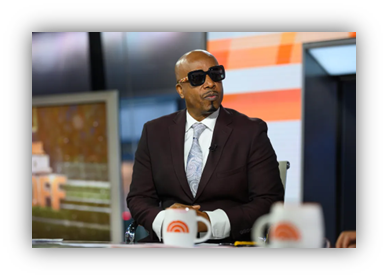
Nowadays Hammer mostly does consultancy work for tech-companies, with a sideline in giving conference speeches and Cheetos commercials…
And oh, in 2011 he announced his own deep-search engine WireDoo – but he still gets a regular “U Can’t Touch This” paycheck. “The period of time over which royalties are collected” has been extended indefinitely.
Back then, when Billboard printed such trigger warnings, everyone was saying that music was doomed – just as they are today – and that it was all Spotify’s fault – just as they are today – for supplying music for “free.” Which is a weird way to describe a subscription service that you pay for, so let me be clear here:
Paying for a Spotify subscription IS paying for music.
- David Byrne complained about music being free, saying that it devalued the whole thing.
- Adele complained about music being free, saying that it devalued the whole thing.
- Taylor Swift famously took her music off of Spotify for a while, upset that fans would be able to listen to her music for “free”, saying that it devalued the whole thing… and yet, weirdly, still allowed radio to play her. This is despite radio literally being free.
If 70% of net revenue doesn’t sound like much to you, then how about the proportion of revenue that radio pays? 0.4¢might sound like small change, but on a per listener basis, it’s infinitely higher than what radio pays. Radio pays virtually nothing.
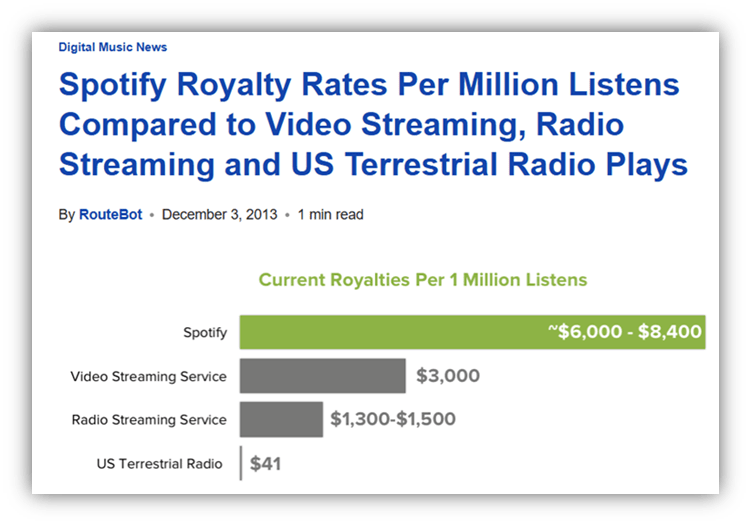
Let’s look at an example: at any one time, 50,000 people are listening to classic-hits station Gold FM Melbourne. In order to merely equal Spotify’s per-listener pay out Gold FM ought to be paying rights holders $200 for every song they play, every time they play it.
Which works out to about 5% of revenue. That’s all they have to pay. It’s the law.
In the U.S. there is a similar law, stating the maximum proportion of revenue that radio stations have to pay (in the U.S. it’s only the songwriters that are paid for radio play, not the performer), a proportion that has recently increased to… wait for it… just over 2%!!
Some say that such a low royalty rate for radio is worth it because then people go and buy the records. But given that the average person only bought a handful of CDs a year, that excuse was obviously a self-serving myth spread by Big Radio.
Why are people more upset about Spotify giving 70% of their revenue to rights holders than they are about radio giving a little over 2%. If you are campaigning against Spotify but not campaigning against radio for doing much, much worse… then what are you even fighting for?
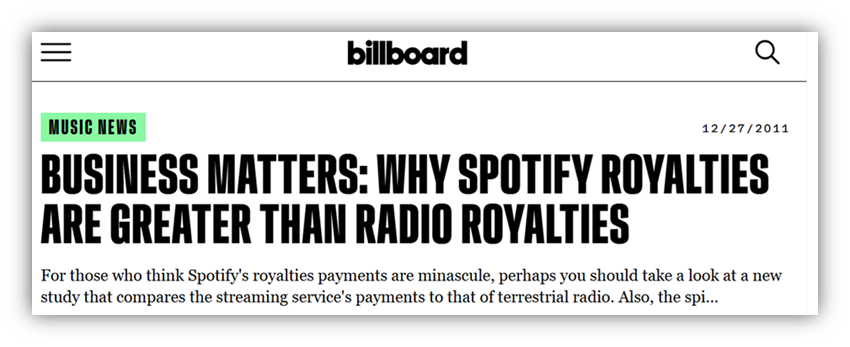
If everybody who listened to the radio switched over to the streaming service of their choice, music industry revenue would go through the roof!
Don’t look at me as though I’m crazy… I’m not the first person to make this argument. Billboard argued the same thing back in 2011:
I mentioned David Byrne before. Turns out that he’s championing a bill called the American Music Fairness Act in order to get radio stations to pay royalties to performers (and not just the songwriters). Go David! I say “turns out” because this bill, despite being in the works since at least 2022, despite having the potential to be a far greater game changer than any increase in Spotify payments ever could, has gotten so little media attention that I wasn’t aware of it until Gene Simmons said something stupid in a Senate Judiciary subcommittee hearing.
Meanwhile, there’s blanket coverage every time Spotify sneezes.
I never felt guilty listening to the radio.
I rarely felt guilty taping songs off the radio. I rarely felt guilty using P2P networks (I was more worried about viruses). I never felt guilty shopping in second hand stores, despite the fact that not a single cent of my purchases there went to the artist,

(I asked one day, they looked at me as though I was mad, they were right to do so).
And yet the same commentators creating endless content bashing Spotify are absolutely gushing about the “vinyl revival” – or more recently the “cassette comeback” – even though a huge bulk of that is second-hand records that – let me repeat this – earn the artists zero. Nonetheless, you can shop for second hand records – posting them onto Instagram for the full performative experience – and still feel morally pure.
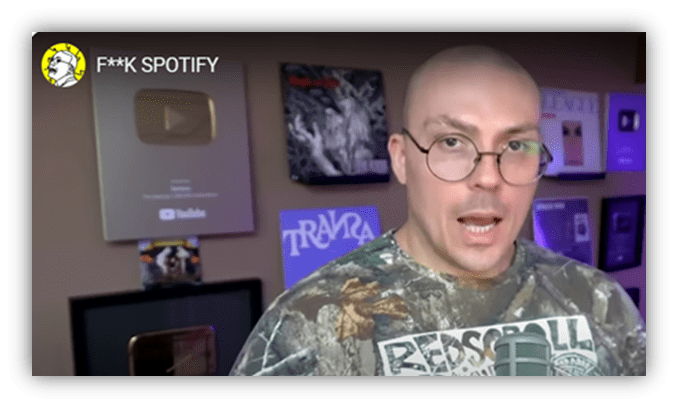
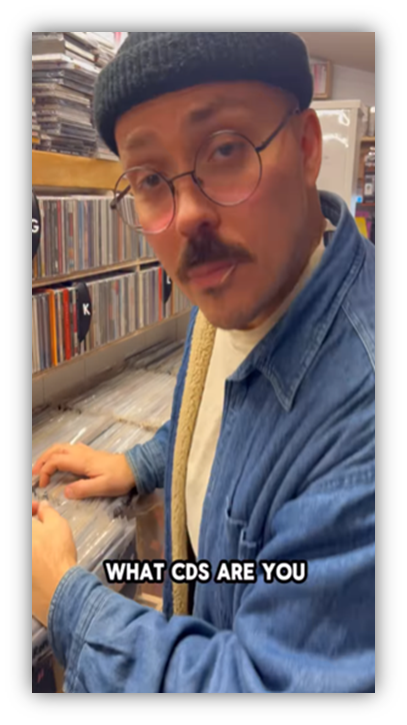
I mean, Fantano’s socials are about equal parts ranting against Spotify for lack of royalty payments,
And hanging out at his favourite second-hand record store.
I ask you, where is the logic in that?
Here’s another thing: buying music – first, not second hand – might be better for the artist whose work you buy, but how about the far greater number of artists whose work you don’t buy? Those artists that you listen to on Spotify that you like fine enough, but don’t love enough to want to buy… but who are still earning royalties from your streams.
Look at what you’ve streamed today… what proportion can you honestly imagine actually buying, if streaming was not an option? I’d suggest that proportion is extremely small, and the very-small per-capita number of CDs that people bought in the pre-streaming era proves it.
So, no… Spotify’s biggest sin is not “joyless, toothless music”, to quote John quoted in Rant No.1.
Spotify’s biggest sin is inspiring a cottage industry of articles designed to ruin your music listening by constantly making you feel guilty about it.
Music used to be fun. I listened to the radio and paid nothing, and nobody tried to make me feel guilty about it. Now I’m simultaneously paying money – for both Spotify and Tidal – and made to feel a nagging guilt that I’m still not paying enough. With all the real problems in the world – with all the threats to the environment, with all the threats to democracy – you’re asking me to feel sorry for… who? Rockstars? Those people with the coolest job in the world?!?!
Or at least I used to think they had the coolest job in the world. But now I’m being asked to consider them as something close to a charity. Now people working in dead-end, soul-sucking jobs are being constantly cajoled into worrying about the financial affairs of celebrities!
Why am I: A f*cking UberEats delivery rider –
– incredibly, not the worst, nor even close to the most soul-destroying job I’ve ever had –
– being asked to spend my waking hours worrying about the royalty payouts of rockstars, possessors of the coolest jobs in the world?
The worst thing is all this guilt is for nothing. Worse than that, it’s self-sabotaging.
It’s endangering the very system that saved the music industry. Worse even than that, it simply hasn’t worked. All this Spotify-shaming, more than a decade of it, constantly, expressed in a progressively frustrated and finger-pointing manner, has achieved nothing in terms of reducing Spotify’s dominant market position.
Why risk this? Do you think that if streaming disappeared tomorrow everybody would go back to buying music? That won’t happen.
They’ll go back to listening to the radio.

Or they’ll use torrent sites (which are apparently still a thing). Or they’ll just not bother and divorce themselves from music altogether. And yet they will still proudly declare that they don’t use Spotify as if they were doing their part.
If anything, the anti-Spotify brigade is holding the music industry back.
By promoting the myth that not subscribing to Spotify is a morally superior pose, they are discouraging who knows how many people from adding their $120 a year to the till. I know people who proudly state they do not use Spotify – or any other streaming service – and let me tell you, they are not spending more money than me on music.
What if – hear me out here – what if, it’s all on purpose? What if all these anti-Spotify think pieces, all this negative publicity, is part of Spotify’s marketing strategy? “
Any publicity is good publicity,” right?
“The only thing worse than everybody talking about you is nobody talking about you.”
This constant stream of anti-Spotify content; it doesn’t hurt Spotify. It helps them. It keeps them top-of-mind. What if this is all part of Spotify’s dastardly scheme?
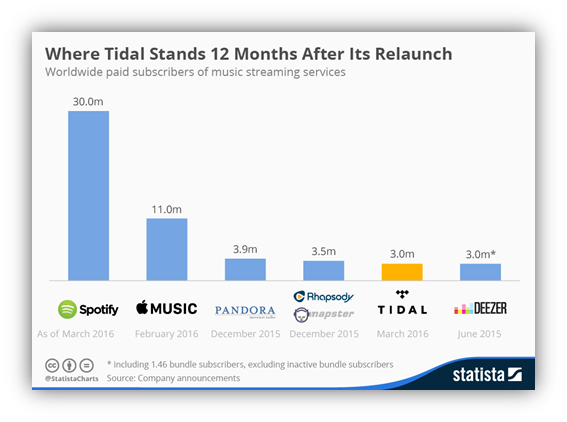
Nobody talks this way about Tidal. Nobody uses them either. Co-incidence? I think not.
Think about it. It makes about as much sense as any other argument about Spotify you are likely to read.
(I’m not going to discuss Helsing because that’s a completely separate company and this rant is already way too long…)
End of series
































Good food for thought. Rather than Spotify, I use YouTube Music because it comes with YouTube Premium. They pay artists less than Spotify, at an average of only $0.00069 per stream. Can you make me feel better about this?
Yes.
I think.
A quick Google suggests that the $0.00069 per stream might be referring to normal YouTube not YouTube Music, which pays out a little more than Spotify.
I could be wrong though, I don’t know much about YouTube Music.
https://labelgrid.com/blog/royalties/youtube-pay-per-stream/
Interesting. “…the volume-weighted average is $0.0071. While this might seem small, it’s higher than what platforms like Spotify and Amazon pay per stream.”
OK, thanks. I fee better.
One notation here: The statement and link about songs not making the Top 40 refers to the Top 40 in the U.K. — several of the songs listed (including the first, Bryan Adams’ “Summer of ’69”) made the Top 40 in the U.S.
True. But the Platinum certification was also referring specifically to the UK, and consequently to streams based out of there.
Some interesting arguments again.
My change in listening methods to streaming is definitely a net loss to the music industry. I pay £21.99 a month for Spotify family plan whereas pre-streaming I would buy at least one CD or album donwload most weeks. Often more. No wonder my savings balance is a lot healthier. Probably spend around a quarter of what I used to on music.
The band Los Campesinos made news earlier in the month when they posted about their streaming income for their 2024 album. Comparing platforms Spotify (for them) has been a lot more scrooge like – making the point that if those Spotify streams transferred to Tidal they’d have doubled their earnings. While with Apple it’d have increased them around 40%.
Reading this I understand all the points you make but then wonder what are the specifics behind why Spotify pay less than Apple / Tidal / Amazon. Is Tidal just a bad business model / have lower profit margins and are Apple & Amazon funding artist remuneration in part through their other extensive business dealings as the music subscription fees look largely in line between all services.
https://loscampesinos.com/heres-how-much-money-los-camp-make-from-streaming/
Mostly it’s because of Spotify’s per-stream-rate is dragged down by the ad-supported free accounts, which don’t earn Spotify much revenue for them to pass on.
Also because Spotify are big in poorer markets where the subscription fee is lower, meaning that, once again, there is less money for Spotify to pass on.
In the case of Los Campensinos, it’s probably due more to the former, since I can’t imagine the Welsh indie cult favourites having many African and Indian fans.
Apple and Tidal don’t offer free-ad supported accounts, so all of their streams are premium. Which means there’s more money per user to pass along. On the other hand however, and as a result of the lack of a free option, there’s also less users. Far less users. And consequently, far less income for artists.
Spotify may pay less-per-stream, the result of lower revenue-per-user, but that very lower revenue-per-user has attracted far more users. And consequently, far more income for artists.
Thanks DJPD. Makes a lot of sense. I can appreciate why Los Campesinos would want to give a nudge to their fans to listen via other platforms and increase their income. While at the same time the reasons you set out mean that probably won’t happen.
If you believe the anti-Spotify hype it would seem there has been a wave of acts exiting the platform. While there are some the reality is its more like a slight ripple. It’ll be interesting whether they see a benefit in keeping their music off it or if its unsustainable and some come back.
So basically, between your article and the comments, my choice of YouTube Music makes me the most ethical consumer I could possibly be (since Tidal is hopelessly glitchy). *dusts shoulders*
My daughter has a YT account for her artwork (no images of her; she’s 12). She needs 10K subscribers to begin earning money from her work.
I told her it’s going to take years to build that type of following, and she’ll need to stay disciplined, releasing videos on a regular schedule to do so.
It’s frustrating, but with fewer gatekeepers to artistic success these days, maybe its more egalitarian. I really don’t know.
A few thoughts…
Its interface has definitely made it easier for me to access music, and I probably listen to more music than I ever have in my life. I don’t go to as many concerts as I did twenty years ago, however, but that has more to do with my life changes than anything.